




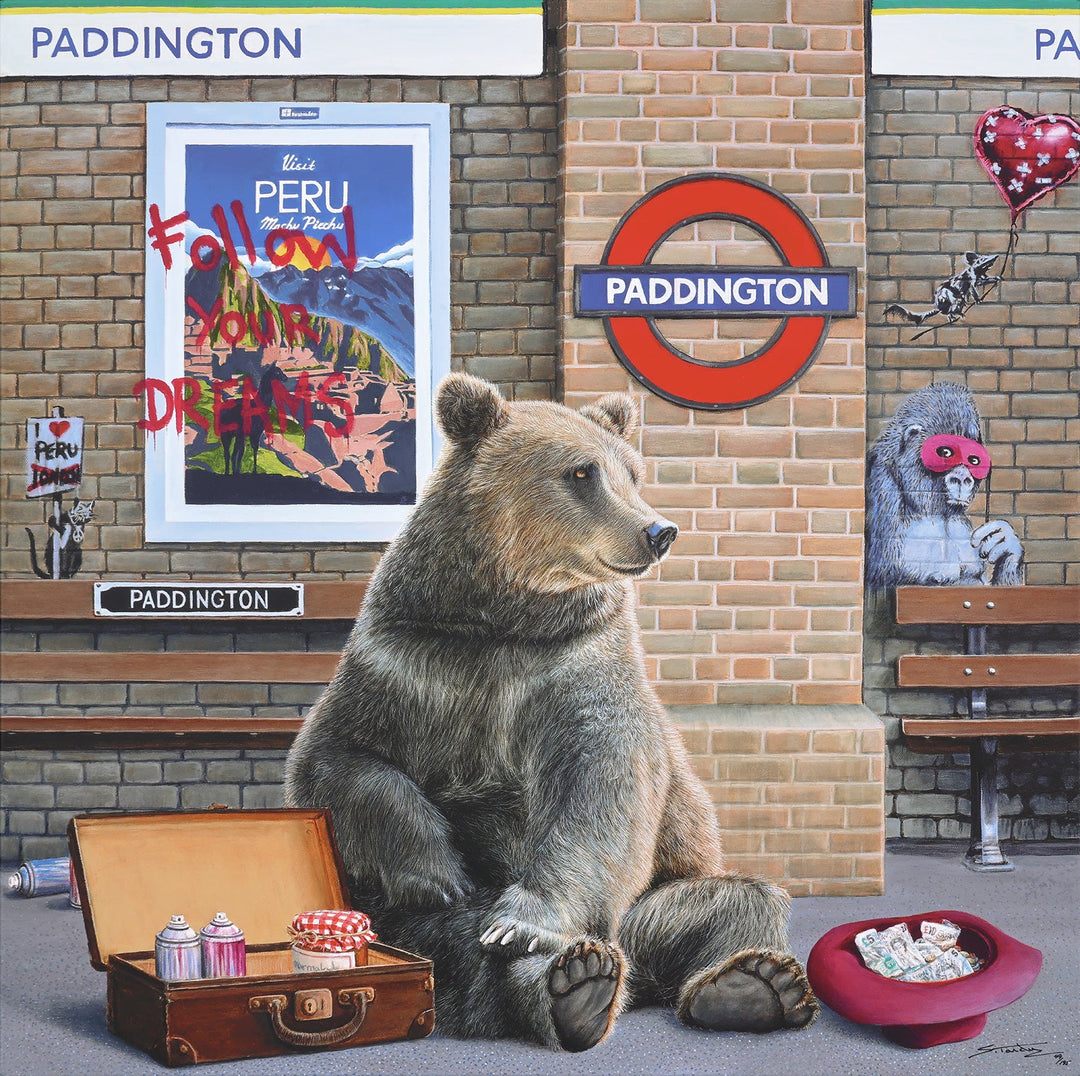
Steve Tandy is a British contemporary artist known for witty, technically accomplished paintings that place wildlife inside the human world. Penguins, pandas, polar bears and big cats adopt familiar poses and inhabit scenes shaped by cinema, popular culture and mid-century style, giving each work an immediately recognisable personality.
Born in Bury in 1973, Steve briefly studied at Bury College but is largely self-taught. While working in insurance, he spent evenings and weekends developing his technique, gradually accepting portrait and landscape commissions before his work was discovered by a gallery.
Influenced by artists including Andy Warhol, David Hockney, Salvador Dalí, Claude Monet, David Shepherd and J.M.W. Turner, Steve brings realism, humour and imagination together. His originals and limited editions are now exhibited across the UK and United States, attracting collectors drawn to their craftsmanship, warmth and playful storytelling.





WILDLIFE | NOSTALGIA | STORYTELLING
When Wildlife Takes Centre Stage
Steve Tandy places animals inside a world usually reserved for people. Penguins ride motorcycles, polar bears become cultural icons and big cats relax beside modernist swimming pools as though they have always belonged there.
The idea is playful, but its success lies in Steve's ability to make each unlikely encounter feel completely convincing. His animals are not treated as cartoons or caricatures. They retain their natural detail and presence while adopting recognisably human expressions, poses and personalities.
Popular culture, art history and mid-century style provide the setting. By replacing the expected human figure with wildlife, Steve turns familiar imagery into something new — creating paintings that feel nostalgic, humorous and gently surreal.
The scene may raise a smile first, but there is often another story waiting beneath it.
From Spare Time to Full-Time Artist
Born in Bury, Greater Manchester, in 1973, Steve showed an early ability for drawing and painting. He briefly studied art at Bury College but is largely self-taught, developing his technique over many years through experimentation, observation and persistent practice.
Although art remained his first love, he initially saw little prospect of turning it into a career. After leaving college, Steve entered the insurance industry and continued painting during evenings, weekends and whatever spare time he could find.
He gradually began accepting private portrait and landscape commissions. These early works allowed him to strengthen the realism and technical control that would later underpin his more imaginative wildlife paintings.
A gallery eventually discovered his work and invited him to produce original paintings and limited editions. That opportunity allowed Steve to leave insurance behind and concentrate fully on his art.
His unconventional route into the gallery world remains an important part of the story: a career built gradually, away from the spotlight, through patience and a determination to keep painting.
Rewriting the Familiar
Steve describes his work as a combination of realism, surrealism and pop-art influence. That balance allows the paintings to sit somewhere between the familiar and the impossible.
His influences are wide-ranging. Andy Warhol and David Hockney can be felt in his use of popular imagery, colour and contemporary culture, while Salvador Dalí introduced the possibilities of surrealism. Claude Monet, J.M.W. Turner and wildlife artist David Shepherd also helped shape his understanding of atmosphere, observation and the natural world.
The visual culture of the 1950s and 1960s provides another rich source of ideas. Classic cinema, vintage cars, motorcycles, fashion and mid-century architecture all appear across his work, alongside references to figures such as James Dean, Marilyn Monroe and Jimi Hendrix.
Yet Steve does more than reproduce a familiar image with an animal inserted in place of a person. He considers which species belongs within each setting, using posture, expression and character to create a new narrative.
A leopard lounging by a pool, a pair of cheetahs exchanging gossip or penguins confronting a celebrated work of modern art can feel strangely natural. The technical realism makes the substitution believable; the imagination behind it makes the scene memorable.
More Than a Smile
Humour gives Steve's work its immediate accessibility, but a quieter environmental message often sits beneath the surface.
Many of the animals he paints face shrinking habitats, climate change or increasing pressure from human activity. By placing them inside our cities, homes and leisure spaces, Steve subtly reverses the usual relationship between people and wildlife.
In Palm Beach Gossip, cheetahs appear perfectly at home beside the symmetry and glamour of a Florida swimming pool, despite their real habitat disappearing elsewhere. Summer in Sorrento recalls the elegance of twentieth-century travel while also acknowledging the uncertain future facing endangered wildlife. Other works draw attention to deforestation and the loss of the natural spaces animals depend upon.
These ideas are never presented as a lecture. Steve allows wit, beauty and storytelling to draw the viewer in before revealing the more serious questions contained within the image.
His original paintings and limited editions are now exhibited across the UK and internationally, attracting collectors who respond to their craftsmanship, character and unmistakable sense of fun.
Steve believes art should make us think or make us smile. At its best, his work manages to do both.
Discover Other Contemporary Artists


Interested in Steve Tandy?
Thinking about adding a Steve Tandy artwork to your collection?
Whether you have a particular piece in mind or would simply like some help exploring Steve’s work, our art consultants are here to help. We can provide additional images and video, discuss individual artworks, framing and delivery, or help you find the right piece for your space.