





What Am I Actually Buying? A Straight-Talking Guide to Art, Editions & Printmaking
The art world has a remarkable ability to make buying something you love sound considerably more complicated than it needs to be.
You spot a piece. You love it. Then you read the description and discover it’s a signed, hand-embellished giclée artist’s proof on 350gsm archival paper.
Right.
So, what exactly are you buying?
The terminology does matter. It tells you something about how an artwork was created, how many exist and sometimes how involved the artist was in producing the finished piece.
But none of it should make buying art intimidating.
So here’s our straight-talking guide to some of the words you’re likely to encounter when looking for art — and what they actually mean.

First things first: what is an original artwork?
An original artwork is a unique work created by the artist. There is only one of that particular piece.
That might be an oil painting on canvas, an acrylic, a watercolour, a charcoal drawing or something made using several different materials.
And that last point matters.
Original doesn’t mean painting.
Artists work with all sorts of materials and processes, so an original might include pencil, ink, pastel, spray paint, collage, gold leaf, resin or just about anything else the artist decides belongs there.
Originals don’t have to be on canvas either. They can be made on paper, board, wood, aluminium and plenty of other surfaces.
You might see descriptions like:
Oil on canvas
Acrylic on board
Mixed media on paper
The first part tells you what the artist used. The second tells you what they used it on.
If there’s only one finished work, you’re looking at a unique piece.

What is a limited edition?
A limited edition is an artwork produced in a predetermined, finite quantity.
You might see something written like:
27/195
That means you’re looking at number 27 from an edition of 195.
Once the edition is complete, no more works should be produced as part of that numbered edition.
Limited editions allow collectors to own work by artists whose unique originals may be considerably rarer or more expensive, while still owning something produced as part of a controlled edition.
Depending on the artwork, the edition might be made using giclée printing, screen printing, photography or another process. It may also be signed by the artist.
And one common question:
Is 1/195 better than 195/195?
Usually, no.
The edition number doesn’t necessarily tell you which print was physically made first, and a lower number doesn’t automatically make it better.
Both are part of the same edition.

What is a giclée?
Let’s deal with the French word.
Giclée — usually pronounced zhee-clay — comes from the French verb gicler, meaning roughly to spray.
In practical terms, it’s a high-quality inkjet printing process used to reproduce artwork with excellent colour, detail and tonal variation.
Professional fine-art printers can use a broader range of pigment-based inks than ordinary commercial printing, which makes giclée particularly good for reproducing subtle changes in colour, texture and detail.
Giclées are commonly printed onto fine-art paper or canvas, although the exact materials vary between artists and publishers.
So, is a giclée just a fancy inkjet print?
Technically, inkjet technology is involved.
But comparing a professionally produced fine-art giclée to your office printer is a bit like comparing a Formula One car to something you use for the school run.
Not entirely wrong.
Not especially helpful.
The printer, inks, colour management and material all make a huge difference.
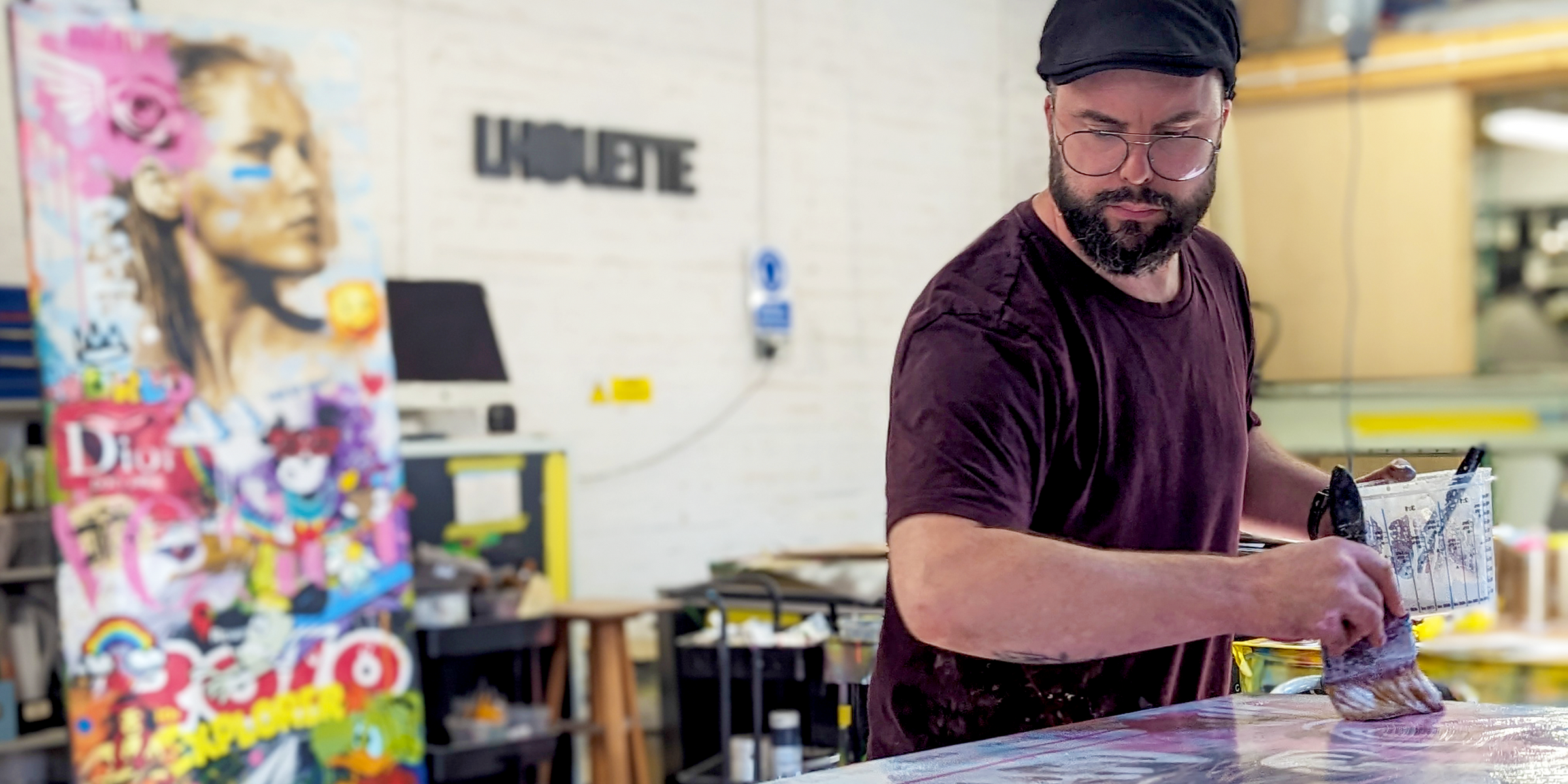

It’s all in the making
Paint, ink, screens, cameras, paper — how an artwork is made can be every bit as interesting as what ends up on the wall.
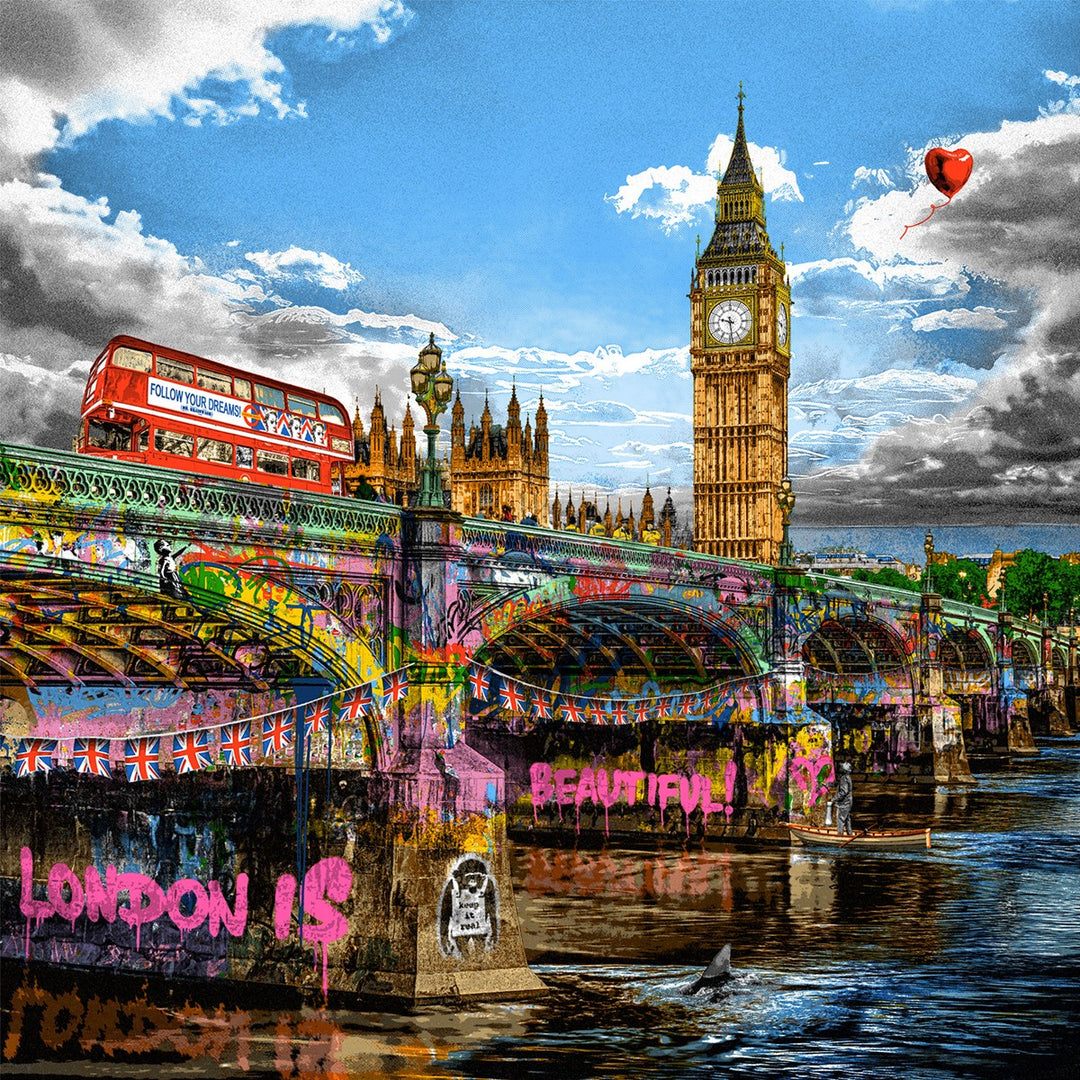
What is a Screen Print?
A screen print is made very differently from a giclée.
Instead of using an inkjet printer, ink is pushed through a fine mesh screen onto the surface beneath it. A stencil controls where the ink can and can’t pass through.
Different colours often require separate screens and passes, so the image is built up layer by layer.
If you’re thinking:
Andy Warhol.
You’re in the right neighbourhood.
Screen printing became closely associated with Pop Art and remains hugely important in contemporary, graphic and street-art-influenced work.
Because ink is physically applied through screens, the finished surface can have a richness and physical quality that feels very different from a digital print.
And no, screen print isn’t automatically “better” than giclée.
They’re simply different processes.
A giclée can be brilliant for reproducing subtle colour and detail.
A screen print can give an artist bold layers, strong blocks of colour and a distinct handmade quality.

What is a C-Type photographic print?
Photography comes with its own terminology, and C-Type is one you’re likely to come across.
A C-Type — short for chromogenic print — is a photographic print produced using light-sensitive photographic paper and traditional photographic chemistry.
Today, the image is often exposed onto the paper using precisely controlled digital light, before the print is chemically developed. So while the photograph may begin as a digital file, the finished work is created using a true photographic process rather than inkjet printing.
That’s the important distinction.
There’s no ink involved.
C-Type printing is particularly known for its smooth tonal transitions, fine detail and rich, continuous colour, qualities that make it a popular choice for contemporary fine-art photography.
And just like other artworks, a C-Type photograph can be produced as a limited edition, signed and numbered by the artist.
So when you see:
C-Type photographic print
you’re not being told what the photograph is of.
You’re being told how the physical photograph was made.

What is Mixed Media?
Mixed media is refreshingly literal.
It means the artist has used more than one material or medium in the same artwork.
That might be acrylic paint with spray paint.
Paint with collage.
Printed elements with gold leaf.
Resin with pigment.
Ink with pencil.
Or all of the above if the artist was having a particularly good day.
Because of that, “mixed media” can describe two artworks that look absolutely nothing alike.
The phrase tells you that several materials have been used, but not necessarily which ones.
That’s why it’s worth reading the full artwork description.
A mixed-media piece might include texture, metallic elements, collage, paint, resin or hand-applied details that change how the work looks depending on light and angle.
It’s one of those terms that sounds vague until you’re standing in front of the artwork.
Then it makes perfect sense.

Now for the Small Print
AP. PP. HC. 27/195. Signed. Certified.
A few marks in the corner of an artwork can tell you rather a lot — once you know what you're looking at.

What is an Artist’s Proof — and what do AP, PP, HC & EA mean?
Those little letters in the corner of an artwork can look like some sort of collectors’ code.
They’re actually quite simple.
AP — Artist’s Proof
Historically, Artist’s Proofs were impressions kept aside for the artist while a print edition was being produced. Today, APs usually sit outside the main numbered edition and are often produced in smaller numbers.
PP — Printer’s Proof
Traditionally reserved for the printer involved in producing the edition.
HC — Hors Commerce
French for outside commerce. These proofs were historically not intended for ordinary commercial sale.
EA — Épreuve d’Artiste
Essentially the French equivalent of Artist’s Proof.
Are they more valuable? Not automatically.
Artist’s Proofs can appeal to collectors because there are often fewer of them, but two little letters don’t magically make an artwork more valuable.
Think of these markings as telling you where your artwork sits within the wider edition.
Useful information — not a secret code you need to memorise.

What does signed actually mean?
Usually exactly what you hope it means:
the artist has physically signed the artwork.
But it’s worth paying attention to how the piece is described.
There’s a difference between a work being hand-signed by the artist and a signature simply appearing as part of the printed image.
You might hear terms such as:
Hand signed
Plate signed
Printed signature
They don’t all mean the same thing.
A hand-signed edition has been physically signed by the artist.
A printed or plate signature forms part of the image itself.
Neither automatically makes an artwork good or bad, but the distinction matters when you’re understanding what you’re buying.
If a signature is important to you, ask.
A good gallery should be able to tell you exactly how the work has been signed and whether the signature is part of the artwork or physically added by the artist.
No detective work required.

What is a Certificate of Authenticity?
A Certificate of Authenticity, often shortened to COA, is documentation that accompanies an artwork and records information relating to its authenticity.
Depending on the work, it may include details such as:
Artist
Artwork title
Medium
Edition number
Edition size
Publisher or studio information
Certificates vary, so they won’t all look the same or contain exactly the same information.
What matters is that the documentation stays with the artwork.
That can be particularly important if the piece is ever resold, insured or passed on.
So when your certificate arrives, don’t put it somewhere “really safe” and immediately forget where that place is.
We’ve all done it.
Keep it somewhere sensible with any invoices, provenance records or other paperwork connected to the artwork.
You may not need it every day.
But future you will be very pleased you know exactly where it is.

Sculpture
Sculpture brings its own language — casts, editions, foundries, patinas and proofs. Here's what you actually need to know.

How can a sculpture be a limited edition?
This one catches people out.
We tend to think of sculpture as a single object, but many sculptures are created through casting or editioning processes.
An artist may create the original form, from which moulds and casts can then be made.
That means a sculpture might be marked:
43/195
Just like a print, that tells you you’re looking at number 43 from an edition of 195.
Depending on the artist, sculptures might be made in bronze, resin, ceramic, metal, glass or mixed materials.
The process can vary enormously from one work to another.
So the fact that a sculpture exists in an edition doesn’t mean it’s simply a “copy” in the everyday sense.
Editioning can be an intentional part of how the artwork was conceived and produced.
And just like prints, sculpture editions can also include Artist’s Proofs and other variations outside the main numbered edition.

What about bronze sculpture?
Bronze sculpture deserves a section of its own because traditional bronze casting is quite a process.
Very broadly, the artist creates the original form, from which moulds can be made.
In traditional lost-wax casting, a wax version is created and used during a multi-stage foundry process before molten bronze is eventually cast into the final form.
The finished bronze can then be chased, refined and given its patina — the surface colour and character of the metal.
Because moulds and casts are involved, bronzes are often produced as numbered editions rather than as one-off objects.
That doesn’t make them less “real”.
The casting process is part of the artwork’s production.
As always, the details matter.
Edition size, foundry, casting method and artist involvement can all vary.
If you’re considering a particular bronze, ask about that specific sculpture rather than assuming all bronzes are produced in exactly the same way.

What is a cold cast resin sculpture?
Despite the name, cold cast resin doesn’t involve pouring molten metal.
Instead, a resin is combined with finely ground metal or mineral powders and poured into a mould. Once cured, the sculpture can be carefully finished and polished to create the appearance and character of materials such as bronze — without using the traditional hot-metal casting process.
You may therefore hear terms such as cold cast bronze, where bronze powder is incorporated into the resin mixture.
The technique allows artists to reproduce intricate details, textures and expressive features particularly well, making it a popular choice for contemporary editioned sculpture.
And yes, a cold cast resin sculpture can still be a limited edition.
Just like an editioned print, each sculpture forms part of a predetermined number and may be individually numbered, signed or accompanied by a Certificate of Authenticity.
So while it might look wonderfully bronze-like, the important distinction is in how it was made and the materials used to make it.
Same idea. Different casting process.

So, what should I actually buy?
By now you know your AP from your PP, your giclée from your screen print and your original from your limited edition.
But there's still one piece of art-world terminology we haven't covered:
The one you can't stop thinking about.
Understand what you're buying. Ask questions. Learn about the artist and the process if it interests you.
Then come back to the question that mattered before you knew what any of these words meant:
Do I want to live with it?
If the answer is yes, you're probably onto something.